Beyond Angkor: Why Is Vietnam Frequently Excluded from the History of Hindu Influence in Southeast Asia?
===== Page 1 =====
The Unseen Temple
Vietnam, Champa, and the Erasure of Hindu Southeast Asia
===== Page 2 =====
Introduction: The Shadow of Angkor
When the modern imagination conjures images of Hindu influence in Southeast Asia, it invariably settles on one monument: Angkor Wat. The vast temple complex in Cambodia, with its soaring towers and intricate bas-reliefs, has become the global symbol of a civilization that once drew its spiritual authority from India. Thailand's royal rituals, the Ramakien epic, and the Brahmin priests who still officiate at court ceremonies reinforce the impression that Hindu influence was primarily a Cambodian-Thai phenomenon.
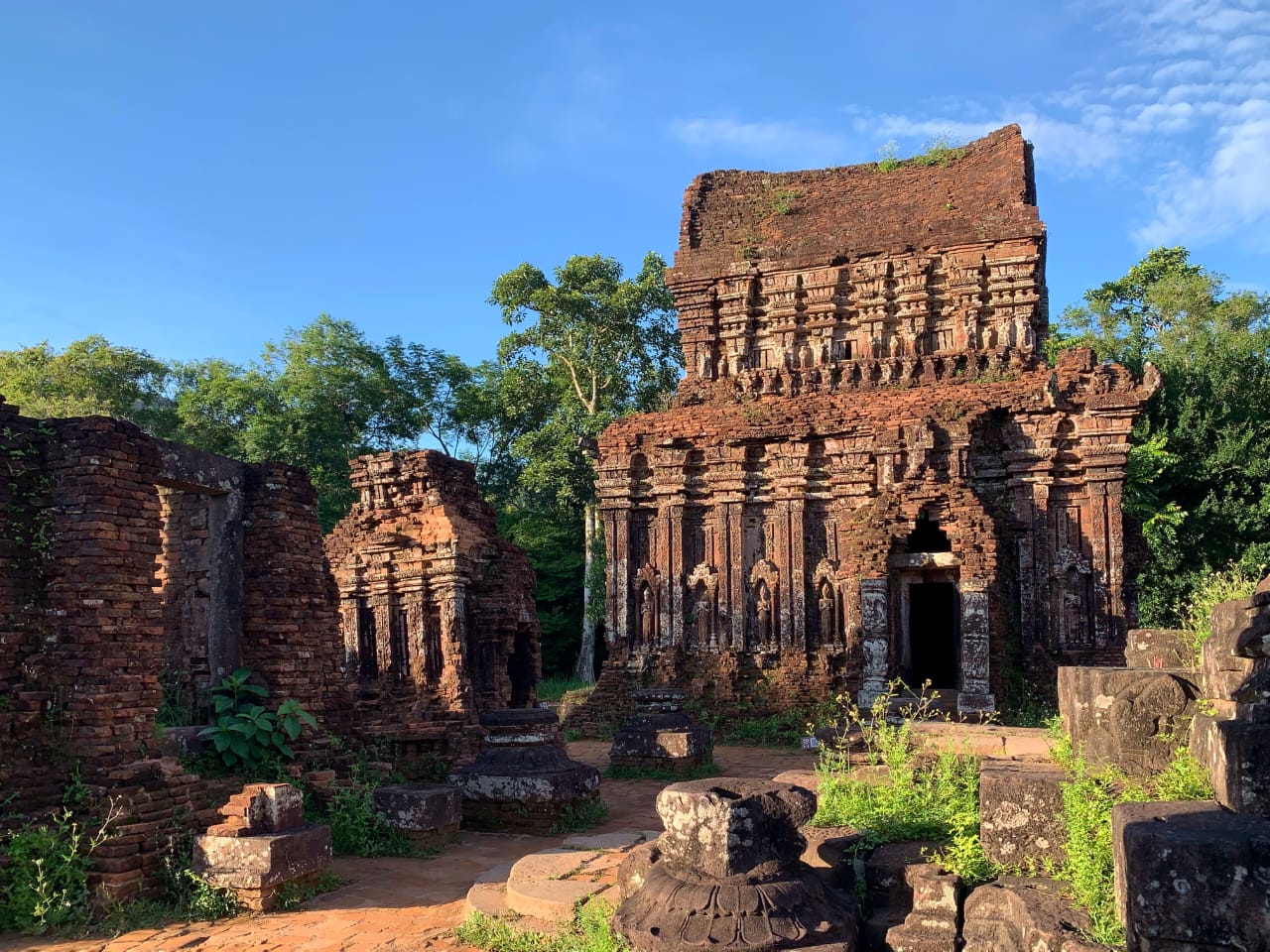
Yet this picture is profoundly incomplete. Approximately 1,000 kilometers east of Angkor, in the coastal mountains of central Vietnam, lie the ruins of Mỹ Sơn —a temple complex that once housed over seventy Hindu temples built between the 4th and 13th centuries. This was the religious and political heart of the Champa Kingdom, a formidable Hindu civilization that flourished for over a millennium, controlled vital maritime trade routes, and developed a unique artistic and architectural tradition that UNESCO has described as "an exceptional example of cultural interchange".
Why, then, does Champa remain a footnote in popular narratives of Hindu Southeast Asia? Why is Vietnam—a country whose central and southern regions were home to some of the region's most vibrant Hindu kingdoms—so frequently excluded from the story?
===== Page 3 =====
The Maritime Highway: Geography as Connector, Not Barrier
The first assumption that must be challenged is that Vietnam was simply "too far" from India to receive substantial Hindu influence. This is a misconception rooted in a land-centric view of history. The Indian Ocean was not a barrier but a superhighway of commerce, culture, and religious transmission.
From the early centuries of the Common Era, maritime trade routes connected the eastern coast of India (particularly the Tamil kingdoms and the Bengal Basin) with the Malay Peninsula, Sumatra, Java, and the coast of mainland Southeast Asia. The Bay of Bengal functioned as an "interaction sphere," a broad network for the movement of goods, people, and ideas. Roman sea trade from the Red Sea penetrated into Southeast Asia through bases on the east coast of India. By the 5th century, the Chinese had recognized that ports in the Java Sea region were becoming dominant in Southeast Asian commerce.
Champa occupied a strategic position along these routes. Its ports, including the famous Kattigara (identified by modern scholarship as a forerunner of Saigon at the mouth of the Mekong River), were vital nodes in the network connecting India, Southeast Asia, and China. The Cham were described by Chinese sources as a seafaring people, dependent economically on international maritime trade. As one scholar notes, Champa was successful in setting up "not only the north-south linkage but also the east-west linkage" across the Asian maritime world.
Geography did not isolate Vietnam from Hindu influence. It made Champa a gateway.
===== Page 4 =====
The Problem of "Indianization": A Theory and Its Critics
For much of the 20th century, the spread of Hindu and Buddhist traditions across Southeast Asia was explained by a concept known as "Indianization." Coined by colonial-era scholars like George Coedès, this theory framed Southeast Asian civilizations as passive recipients of a superior Indian civilization. As one scholar notes, "Indian influence is an essential part of Southeast Asia's cultural history, but it has also been a controversial one," with some Indian nationalists coming to see Southeast Asian cultures as products of an ancient 'colonization' by Indians.
This framework has been thoroughly critiqued by later scholarship. The historian O.W. Wolters argued that the transmission of Indian ideas is best described as a process of "local construction" —Southeast Asian rulers selectively adopted foreign ideas in search of greater authority and legitimacy, fundamentally reshaping them in the process. Wolters' concept of "localization" refers to the process by which an imported culture tends to be "fractured and restated and therefore drained of original significance".
Amitav Acharya, in his work Civilizations in Embrace, frames this as neither "wholesale transplantation" nor a "thin, flaking glaze," but a dynamic process of convergence. The resulting civilizations were not "Indian colonies" but original Southeast Asian syntheses.
The old "Indianization" model obscured Champa's achievements by framing them as mere derivatives. The localization model reveals them as creative adaptations.
===== Page 5 =====
Vietnam as Several Historical Regions
A fundamental obstacle to recognizing Hindu influence in Vietnam is the anachronistic projection of modern national borders onto the ancient past. The Socialist Republic of Vietnam is a 20th-century creation that unites three historically distinct cultural zones:
Northern Vietnam (Đại Việt): From 939 CE onward, this region maintained an independent kingdom shaped by a millennium of Chinese administrative influence, Confucian education, Mahayana Buddhism, and the use of classical Chinese as the written language of government. This is the Vietnam of the Red River Delta—the Vietnam most familiar to outsiders.
Central Vietnam (Champa): This narrow coastal strip, from the Hoành Sơn mountains in the north to present-day Bình Thuận province in the south, was the heartland of the Cham kingdoms. From the 2nd century CE until the 15th century, this region belonged to a completely different cultural world—Indic in its religious orientation, Austronesian in its language, and maritime in its economy.
Southern Vietnam (Mekong Delta): This region, originally part of the Khmer Empire, was only gradually incorporated into Vietnamese territory from the 17th century onward through a process of southward expansion (Nam tiến).
Modern Vietnam thus contains the ruins and descendants of a Hindu civilization that was politically and culturally independent of—and frequently at war with—the Vietnamese state to its north. To speak of "Hindu influence in Vietnam" is to speak of a civilization that Vietnam itself conquered and absorbed.
===== Page 6 =====
The Champa Kingdoms: A Civilization of Towers
The Champa Kingdom is conventionally dated from 192 CE, when the Dua Clan unified the various Cham clans in central and southern Vietnam to form a single state. The kingdom is known from Chinese records, in which it appeared successively as Lam Ap, Hoan Vuong, and Chiem Thanh—a transcription of the Sanskrit Champapura, meaning "the city of the Cham people".
The Cham economy was based on three pillars: wet-rice agriculture, fishing, and seaborne trade. The kingdom was divided into five regions: Indrapura (religious center), Amaravati (present-day Quảng Nam), Vijaya, Kauthara (modern Nha Trang), and Panduranga (modern Phan Rang).
The religious life of Champa was dominated by Shaivism—the worship of Shiva. Many temples were built to Hindu divinities including Krishna and Vishnu, but "above all Shiva". Mahayana Buddhism penetrated Cham culture, probably in the 4th century, but "Shiva Hinduism remained the state religion".
The most important religious center was Mỹ Sơn (Vietnamese for "Beautiful Mountain"), a valley surrounded by mountains that served as the religious and political capital of the Champa Kingdom for most of its existence. UNESCO's description is worth quoting in full:
"Between the 4th and 13th centuries a unique culture which owed its spiritual origins to Indian Hinduism developed on the coast of contemporary Viet Nam".
===== Page 7 =====
Shiva, Vishnu, and the Cham Transformation of Hindu Deities
The Hindu pantheon in Champa was not a simple copy of Indian prototypes. The Cham developed localized forms of Hindu deities that cannot be found anywhere else in the world.
The linga—the aniconic representation of Shiva—was central to Cham royal religion. Inscriptions reveal that kings consecrated lingas to legitimate their rule and ensure the "long-term happiness of the kingdom". One of the earliest known Cham kings, Bhadravarman (ruled c. 349-361 CE), is described in Sanskrit inscriptions as being "versed in the Vedas." He built temples, conquered rivals, and ultimately abdicated his throne to spend his final days in India on the banks of the Ganges.
The Vo Cạnh stele, dating to the 3rd–4th centuries CE, is the earliest evidence of the introduction of Sanskrit language and religious thought from India into Champa. It is also the oldest such inscription in Southeast Asia. The stele records the merit of a king from the Sri Mara family—identified by some scholars as a Tamil Pandyan ruler. The oldest Sanskrit inscription discovered in Vietnam mentions the name of Sri Maran, whom scholars connect to the Pandyan dynasty of Tamil Nadu.
Later inscriptions, such as the Hoa Lai stele (8th–9th century) and the Phước Thiện stele, detail the religious life of the Cham people in their worship of Brahma, Vishnu, and Shiva. The Cam Thịnh Đông steles (14th–15th centuries) record the reign of King Vīrabhadravarmadeva.
The epigraphic record demonstrates that Sanskrit was not merely a liturgical language but a living medium of political and religious expression in Champa for over a millennium.
===== Page 8 =====
Kingship and Divine Authority: The Devaraja Across Kingdoms
The concept of the devaraja (god-king) was central to both Khmer and Cham political theology. The cult taught that the king was a divine universal ruler, a manifestation of Shiva or Vishnu. Temple-mountains—the symbolic recreation of Mount Meru, the cosmic center of Hindu cosmology—were built to celebrate the king's divine rule.
In Champa, the connection between kingship and sacred geography is vividly illustrated at Mỹ Sơn. The tower temples "have a variety of architectural designs symbolizing the greatness and purity of Mount Meru, the mythical sacred mountain home of Hindu gods at the center of the universe, now symbolically reproduced on Earth in the mountainous homeland of the Cham people".
The devaraja cult in Champa may have spread from Java, according to some scholars. What is clear is that both Champa and Cambodia shared a common political vocabulary derived from Indian models—yet each localized it according to indigenous needs.
The difference is not that Champa lacked Hindu kingship, but that its monuments were built of brick rather than stone, making them more vulnerable to the elements and to later destruction.
===== Page 9 =====
Cambodia and the Preservation of Memory
Why, then, is Cambodia remembered while Champa is forgotten? The answer lies partly in the material preservation of monuments.
Angkor Wat was constructed primarily of sandstone, a material that resists decay. The Cham, by contrast, built their temples primarily of fired brick with stone pillars and sandstone bas-reliefs. Brick is more vulnerable to weathering, vegetation growth, and collapse. The tropical climate of central Vietnam—with its heavy monsoon rains and dense jungle—has been far less forgiving than the relatively drier climate of the Angkor region.
Moreover, Angkor benefited from continuous royal patronage and was never entirely abandoned. The site remained a place of Buddhist pilgrimage and royal ceremony, ensuring its preservation. Mỹ Sơn, by contrast, was abandoned after the fall of Vijaya in 1471 and gradually reclaimed by jungle. Its rediscovery by French scholars in the late 19th century came too late to prevent extensive damage from vegetation and looting.
The French colonial project in Indochina also shaped historical memory. The École Française d'Extrême-Orient (EFEO) conducted extensive research and restoration at Angkor, making it a global icon of French colonial scholarship. Champa received less attention. As one scholar notes, the "Indianization" theory "informed the French/Dutch/Indian scholarly engagement with the Cambodian and Javanese templescapes".
Angkor's sandstone and French patronage made it a global monument. Champa's brick and relative neglect consigned it to scholarly obscurity.
===== Page 10 =====
Thailand: The Transformation of Hindu Traditions
Thailand, unlike Vietnam, has integrated its Hindu heritage into a predominantly Buddhist national identity. The Ramakien, Thailand's national epic, is a direct adaptation of the Ramayana. The city of Ayutthaya is named after Ayodhya, the birthplace of Rama. Brahmin priests continue to officiate at royal ceremonies, and Hindu deities are venerated alongside Buddhist figures.
This integration occurred because the territories that became Thailand were never subjected to the same Sinicizing pressures as northern Vietnam. The Mon, Khmer, and Thai kingdoms that preceded modern Thailand all participated in the Sanskrit cosmopolitan culture. When Theravada Buddhism became dominant, it did not erase the Hindu past but incorporated it.
In Vietnam, by contrast, the Vietnamese state that absorbed Champa was deeply influenced by Chinese political and intellectual traditions. The Hindu heritage of the conquered territories was not incorporated but suppressed or marginalized—a conquered people's religion, not a foundational element of national identity.
===== Page 11 =====
The Đại Việt-Champa Conflict and the Erasure of Champa
The relationship between Đại Việt and Champa was one of centuries of conflict, punctuated by periods of alliance and intermarriage. The wars were costly and destructive.
The decisive blow came in 1471, when Emperor Lê Thánh Tông of Đại Việt launched a military expedition that destroyed the Cham capital of Vijaya. This was not merely a military defeat but a systematic destruction of Cham political and religious institutions. The Vietnamese armies "carried out a series of attacks upon the neighbouring realm of Champa, killing tens" of thousands.
The consequences were profound:
· The Cham political structure collapsed.
· Cham territories were gradually absorbed into the Vietnamese state through the process of Nam tiến (southward expansion).
· Cham religious institutions were destroyed or converted.
· Cham elites were killed, displaced, or assimilated.
The final Cham territory, Panduranga in the far south, was not conquered until the 19th century. But by then, the great Hindu civilization of Champa had been reduced to a memory.
The conquest of Champa was not merely a territorial expansion but a cultural erasure. The victors wrote the history, and the vanquished became a footnote.
===== Page 12 =====
Cham Communities in the Present: Survivors and Syncretists
Despite the conquest, the Cham people did not disappear. Today, approximately 160,000-170,000 Cham live in Vietnam, primarily in the central and southern provinces.
They are divided into two main religious communities:
· Balamon Cham (Hindu): Approximately 15-20% of the Cham population, concentrated in Ninh Thuận province (10.4%) and Bình Thuận (4.8%). They are one of only two surviving non-Indic indigenous Hindu peoples in the world.
· Cham Bani (Muslim): Approximately 80-85% of the Cham population, concentrated in the Mekong Delta. They practice a unique form of Islam influenced by local traditions.
The term "Chăm Bàlamôn" —adapted from the French "Cham Brahmanistes"—has become the official state-sanctioned term for the Hindu Cham community. Four Hindu temples continue to be worshipped today: Po Inu Nugar, Po Rome, Po Klaung Girai, and Po Dam.
The Cham Ahiér are described as "predominantly Hindu practitioners, although the religion exhibits flares of animistic, shamanistic, and Islamic influence". Their identity is complex and layered—not a "pure" Hinduism but a living, evolving tradition that has absorbed influences from multiple sources.
The continued existence of Cham Hindus challenges the narrative that Champa is merely a "lost civilization." It is a living people with a living faith.
===== Page 13 =====
Buddhism and Hinduism: Interacting Traditions
The rigid separation of "Hinduism" and "Buddhism" as distinct religions is a modern category that does not always apply to premodern Southeast Asia. In Champa, the two traditions coexisted and interpenetrated.
The Vo Cạnh stele, the earliest evidence of Indian influence in Champa, contains both Hindu and Buddhist elements. The inscription speaks of "lokasyàsya gatàgati" (the death and survival/come and go in this world) and "prajànàn karuna" (tolerance/merciful compassion for sentient beings)—phrases that reflect Buddhist influence from India. Yet the same kingdom that produced these inscriptions also built Shiva temples.
Mahayana Buddhism "penetrated the Cham culture later, probably in the 4th century, and became strongly established in the north of the Champa Kingdom, but Shiva Hinduism remained the state religion". In the 10th century, the influence of Buddhism began to wane, "to the advantage of My Son, where Hinduism had always been strong".
The Cham were not "Hindu" or "Buddhist" in the exclusive sense. They were participants in a religious continuum where different traditions addressed different needs—royal legitimation, personal salvation, community welfare—without the sharp boundaries imposed by later doctrinal definition.
===== Page 14 =====
The Comparative Civilizational Perspective
The transmission of Indian traditions to Southeast Asia can be compared to other historical processes of cultural diffusion:
Process Source Recipient Nature of Transmission
Hellenization Greek city-states Mediterranean, Near East Military conquest, colonization
Romanization Roman Republic/Empire Western Europe, North Africa Military conquest, administration
Sinicization Chinese Empire Korea, Japan, Vietnam Military threat, diplomatic tribute, cultural prestige
Indianization Indian subcontinent Southeast Asia Trade, royal patronage, cultural prestige
Islamization Arabian Peninsula Middle East, Africa, Asia Military conquest, trade, Sufi networks
Christianization Roman Empire/Europe Americas, Africa, Asia Colonial conquest, missionary activity
The key distinction is that Indianization was not primarily a process of conquest or colonization. It was a voluntary adoption by Southeast Asian elites of foreign cultural forms that conferred prestige, legitimacy, and cosmopolitan connections. As Acharya notes, this was not a case of "wholesale transplantation".
Champa's adoption of Hindu traditions was not a sign of subordination to India but a strategic choice by Cham rulers to participate in a wider cosmopolitan culture. This is precisely why the term "Indianization" is misleading—it implies passivity where agency was paramount.
===== Page 15 =====
Colonial Scholarship and the Construction of Categories
The categories we use to describe Southeast Asian history—"Indianized," "Hindu," "Vietnamese," "Cham," "Khmer"—are themselves products of colonial scholarship.
French scholars in Indochina, British scholars in India and Malaya, and Dutch scholars in Indonesia all participated in a project of categorizing and classifying Southeast Asian civilizations according to European intellectual frameworks. The concept of "Indianization" was central to this project, as it allowed European scholars to explain the sophistication of Southeast Asian civilizations without acknowledging indigenous agency.
This categorization had political implications. In French Indochina, the classification of Champa as a "Hindu" civilization—and therefore distinct from the "Sinic" Vietnamese—served colonial administrative purposes. It also contributed to the marginalization of Cham history within Vietnamese national narratives.
After independence, Vietnamese nationalist historians emphasized the Vietnamese character of all territories within modern borders. Cham history was incorporated into Vietnamese history as a prelude to Vietnamese unification—not as an independent civilization with its own trajectory.
Colonial and nationalist scholarship, in different ways, collaborated in the erasure of Champa's distinctiveness.
===== Page 16 =====
Modern National Borders and Historical Memory
Contemporary nation-states actively shape the way premodern history is taught and remembered.
In Cambodia, Angkor is the centerpiece of national identity. The Cambodian government promotes Angkor as a symbol of Khmer greatness, and UNESCO World Heritage status has made it a global tourist destination. The Hindu origins of Angkor are acknowledged but framed as part of a continuous Khmer civilization that eventually embraced Buddhism.
In Thailand, Hindu-influenced royal rituals and the Ramakien epic are integrated into a Buddhist national identity. The Hindu elements are not denied but presented as part of a syncretic Thai tradition.
In Vietnam, the situation is different. Champa is taught as a "minor" kingdom that was eventually absorbed into the Vietnamese nation. Mỹ Sơn is a UNESCO World Heritage site, but it is often presented as an example of "Cham culture" rather than as part of a wider Hindu Southeast Asian civilization. The Hindu religious context is mentioned but not emphasized.
Textbooks, museums, heritage policies, and tourist marketing all determine which histories become globally visible. Champa's relative invisibility is not an accident of history but a product of deliberate choices about what to remember and what to forget.
===== Page 17 =====
Popular Media and Historical Oversimplification
Documentaries, social-media videos, and general history books repeatedly focus on Angkor Wat while giving limited attention to Mỹ Sơn, Champa, or the maritime networks connecting these regions.
This is partly a matter of spectacle. Angkor Wat is visually stunning—the largest religious monument in the world. Its sandstone towers, intricate bas-reliefs, and vast scale make for compelling imagery. Mỹ Sơn, by contrast, consists of smaller brick towers, many damaged by war and weather. It is impressive but not spectacular in the same way.
There is also a tendency to create simple civilizational maps: "Chinese Vietnam," "Hindu Cambodia," "Buddhist Thailand." These maps are seductively simple but profoundly misleading. They erase the complexity of cultural overlap and the fact that modern national borders are recent constructions.
The desire for simple categories produces simple narratives. The reality was far more complex.
===== Page 18 =====
Common Misconceptions and Their Correction
Misconception Reality
"Hindu influence in Southeast Asia was primarily Cambodian." Hindu kingdoms existed across the region, including Champa (Vietnam), Srivijaya (Sumatra), and Majapahit (Java).
"Vietnam was always part of the Sinic cultural sphere." Central and southern Vietnam were home to Hindu kingdoms for over a millennium.
"Champa was a minor kingdom." Champa controlled vital trade routes, was renowned for its wealth, and was powerful enough to sack Angkor in 1177.
"Hinduism in Champa was a direct copy of Indian models." Cham Hinduism developed local forms of deities that cannot be found anywhere else in the world.
"The Cham people no longer exist." Approximately 160,000-170,000 Cham live in Vietnam today, with significant Hindu and Muslim communities.
"My Son is just a minor archaeological site." Mỹ Sơn was the religious and political capital of Champa for most of its existence, with over 70 temples built over ten centuries.
===== Page 19 =====
Conclusion: Remembering the Forgotten
Vietnam is frequently excluded from popular discussions of Hindu-influenced Southeast Asia not because Hindu traditions failed to reach its shores, but because of a convergence of factors:
1. Modern Vietnam combines territories that historically belonged to different cultural zones. The northern, central, and southern regions had distinct histories, but the northern narrative became dominant.
2. The Vietnamese conquest and absorption of Champa reduced the political visibility of Cham history. The victors wrote the history.
3. Cambodia possesses exceptionally famous and well-preserved monumental architecture. Angkor's sandstone has survived better than Champa's brick.
4. Modern national borders encourage the projection of present-day identities backward into the ancient past. The "Vietnamese" identity of central Vietnam obscures its Cham history.
5. Popular history tends to divide Southeast Asia too neatly into "Indian" and "Chinese" cultural spheres. Vietnam is placed in the Chinese sphere, ignoring its central and southern regions.
6. Cham religious traditions are less internationally familiar and are complicated by the later growth of Islam among many Cham communities.
7. Tourism, colonial archaeology, state heritage policies, and global media have made Angkor more visible than Cham sites.
The exclusion of Vietnam from the narrative of Hindu Southeast Asia is not a reflection of historical reality but a product of modern historical memory.
===== Page 20 =====
Epilogue: The Light That Remains
Mỹ Sơn was heavily damaged by American bombing during the Vietnam War. Many of its towers are now ruins. Yet the sanctuary remains, a testament to a civilization that once flourished on the coast of what is now Vietnam.
The Balamon Cham continue to worship at their temples, maintaining traditions that have survived conquest, conversion, and marginalization. They are the living link to a civilization that most of the world has forgotten.
The project of remembering Champa is not merely an academic exercise. It is an act of historical justice which is recognition that the history of Hindu Southeast Asia is not a single story centered on Angkor but a tapestry of many kingdoms, many temples, and many peoples.
To remember Champa is to remember that civilizations are not defined by their survival but by their existence. The Cham built temples, wrote inscriptions, worshipped gods, and created a culture that was uniquely their own—a synthesis of Indian ideas and indigenous traditions that produced something new and beautiful.
The towers of Mỹ Sơn stand in silence, waiting to be remembered.